
Research / Competitors
Research
Competitors
Who your competitors are, what they charge and where they're weak — and how to check it.
Before you set a price or write a headline, it helps to know who else your customers could choose — and why they might not. Firelent gives you a fast first map of your competition: who they are, what they typically offer and charge, what their customers complain about, and the gap you could own.
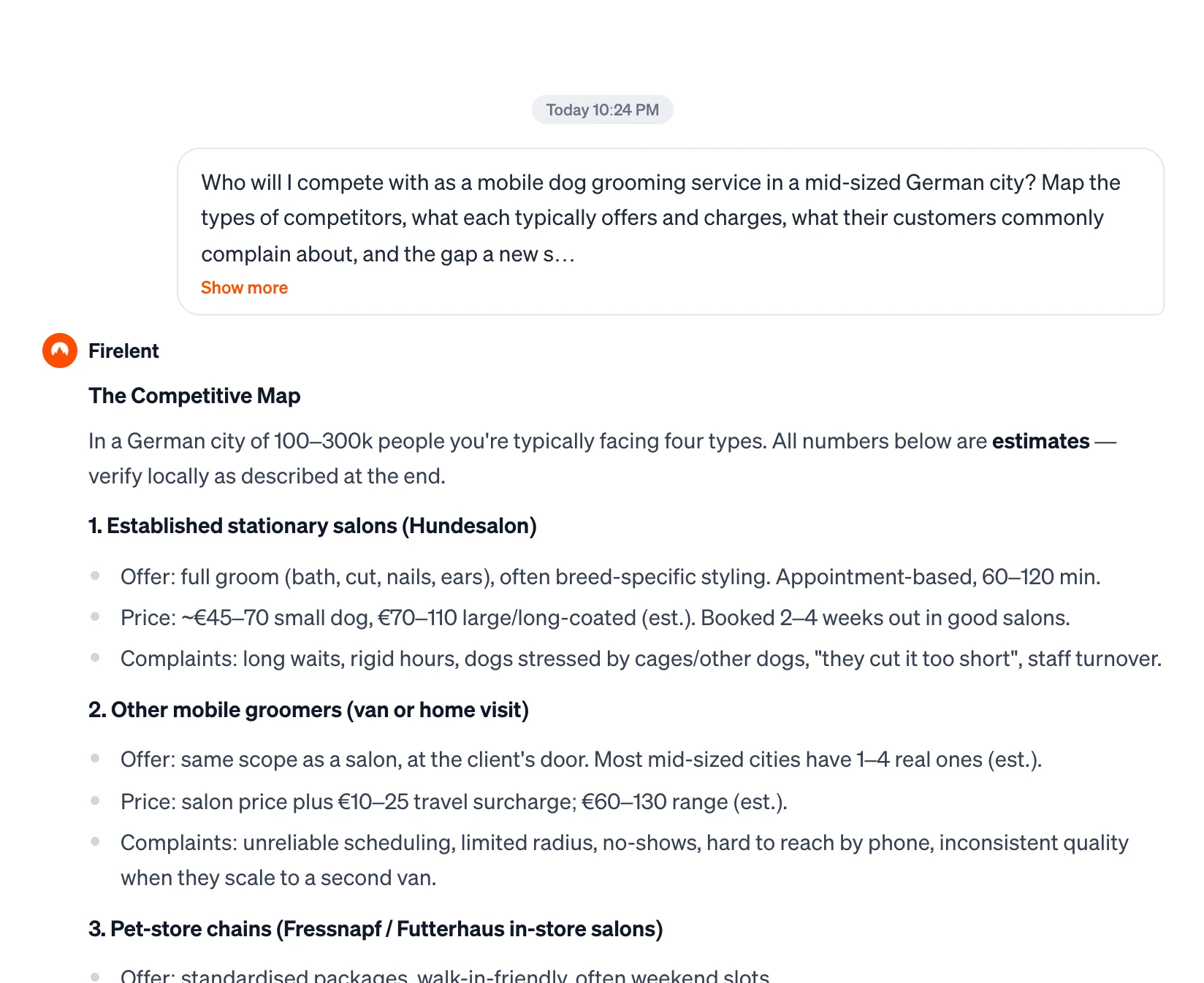
How research works#
Open Research
On your dashboard, click Research and choose Competitors.
Ask your question
Start from one of the ideas or write your own. Under Deliver as, pick Quick answer, Deep dive, Report or Comparison.
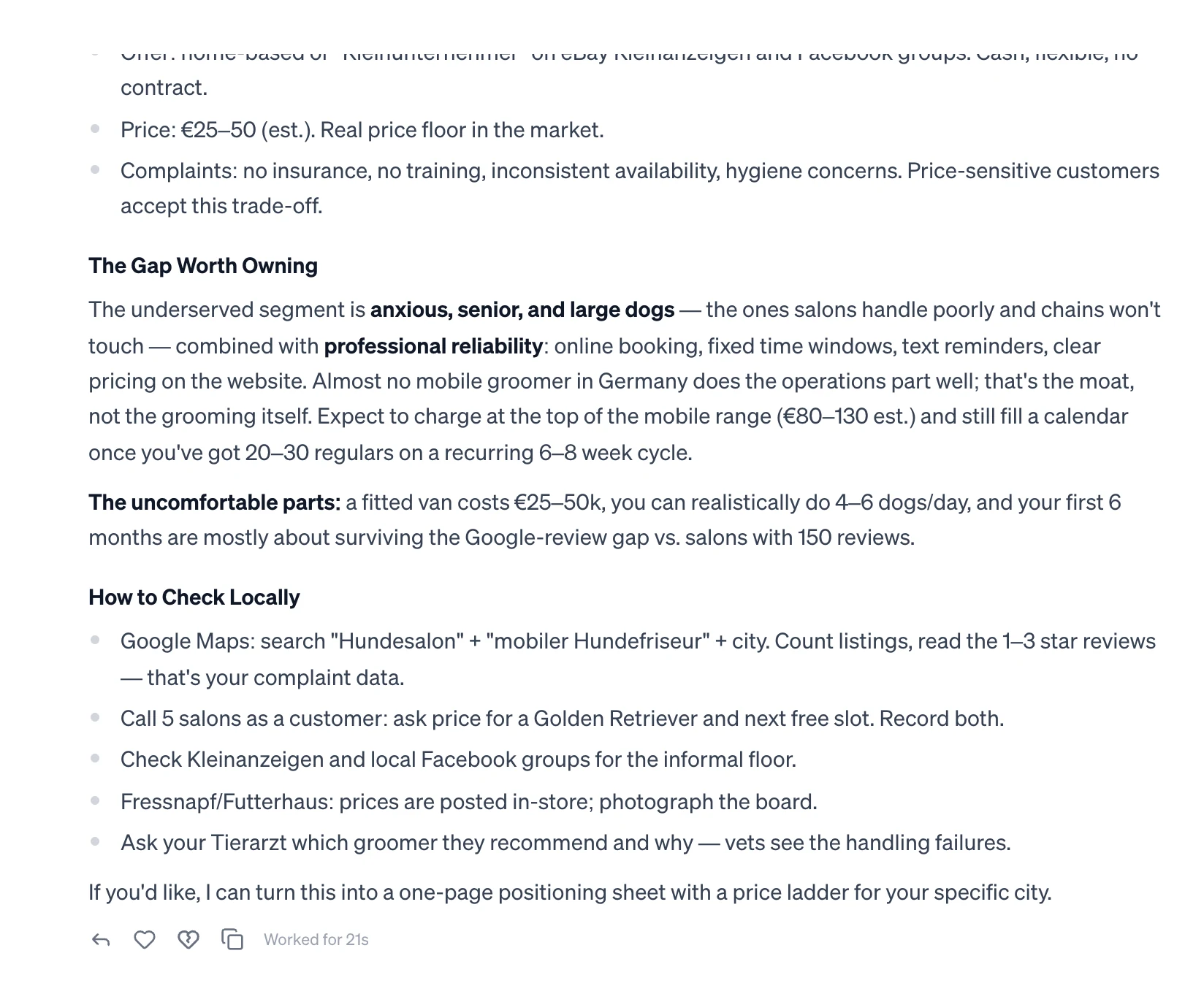
Read the answer
The answer appears in the chat, with headings, lists and tables. Copy it with one click.
Dig deeper
Ask follow-up questions in the same chat — Firelent remembers the last few exchanges.
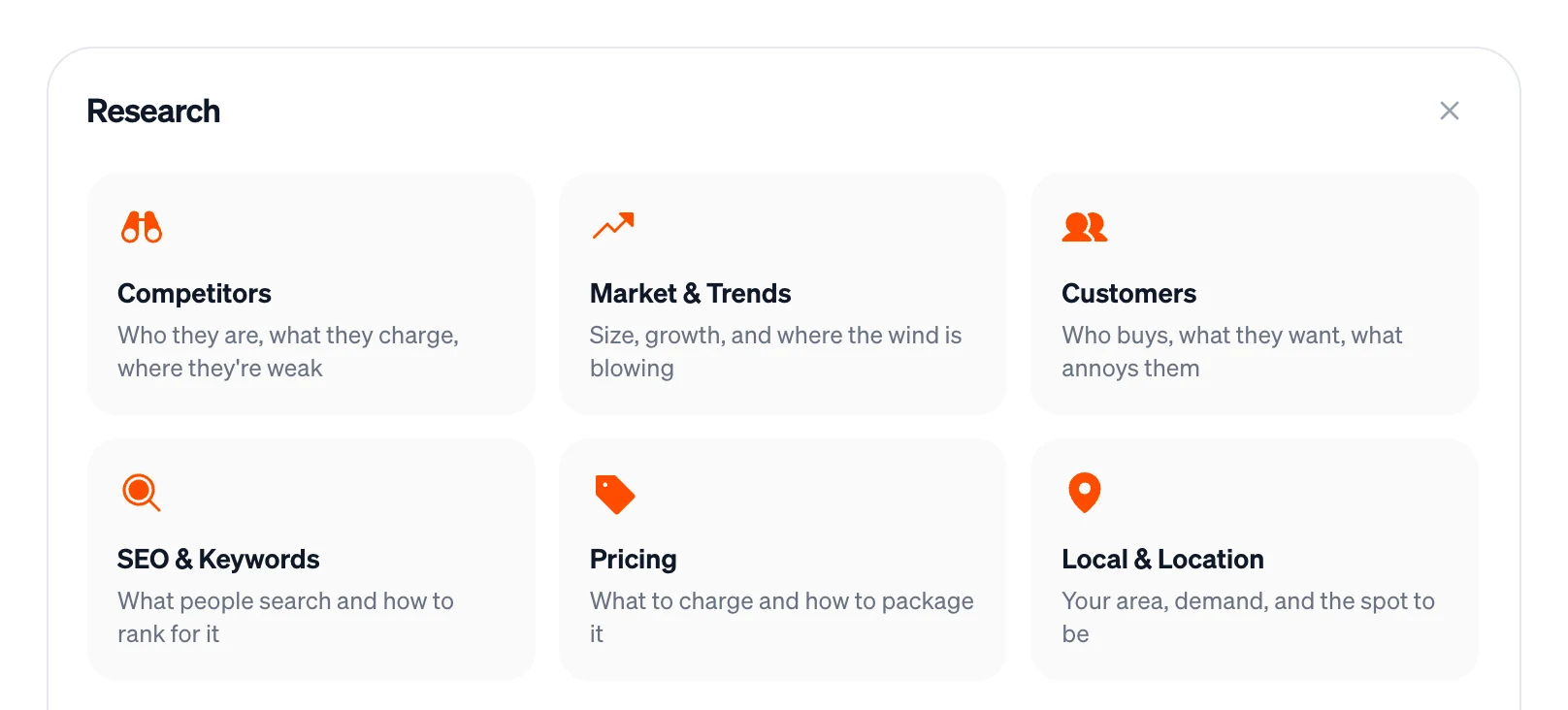
Research answers are free. Your Deliver as choice is added to your question as a preference; for a reliable format, also say it in your own words — “as a table”, “in five bullet points”.
Answers come from the AI's knowledge, not live web data
Firelent doesn't search the web or open websites for research yet. Answers draw on what the AI model already knows, so prices, names and numbers are estimates and may be out of date, and they come without links to sources. Use them as a head start, and check what matters before you act on it — this page shows how.
Read answers like an analyst#
AI answers sound confident even when they're guessing — and they tend to agree with you. A few habits keep you honest:
- Name your decision first. “Should I open in district A or B?” gets you further than “tell me about cafés”.
- Ask for labels. “Mark each claim as fact, estimate, assumption or opinion.”
- Ask what would change the answer. “What would have to be true for this to be wrong?”
- Ask for the counter-case. “Argue the strongest case against my idea.”
- Check the numbers that decide something — with two or three independent sources, or your own data.
What to ask#
A good competitor question names your business, your place and what you want to know:
- Who: the types of competitors — direct ones, indirect ones, and what customers do instead (doing it themselves, waiting, not buying).
- Offer: what each typically includes, and how it's sold.
- Price: typical ranges, marked as estimates.
- Weak spots: what their customers commonly complain about.
- Your gap: the customers or needs nobody serves well.
Who will I compete with as a mobile dog grooming service in a mid-sized German city? Map the types of competitors, what each typically offers and charges, what their customers commonly complain about, and the gap a new service could own. Mark every number as an estimate and tell me how to check it locally.
Asking Firelent to mark estimates and tell you how to check them is the most useful habit in research — you get a map and a to-do list in one answer.
Check it yourself#
Spend an afternoon turning estimates into facts. All of these are free:
| Source | What it tells you |
|---|---|
| Google Maps | Who's actually near you, their ratings and how many reviews they have |
| Their 1–3 star reviews | What customers complain about — in their own words |
| Their websites | Offers, prices, how booking works, what they promise first |
| Calling or booking as a customer | Real prices, waiting times and how they treat people |
| Classifieds and local groups | The informal competition and its price floor |
| People who refer customers | Who they recommend and why — vets, landlords, accountants, neighbours |
For a company's legal details, the German company register (Handelsregister) is free to search. To see how a competitor's website and prices looked in the past, try the Wayback Machine.
Write what you find into one simple table: competitor, offer, price (with the date you saw it), rating, biggest complaint, what they do well. Five to ten rows is enough for a small business — three to five direct competitors, two or three alternatives (including doing it yourself), and one or two you look up to.
Find your angle#
Competitor research is only useful if it changes what you do. Look for:
- A complaint that keeps coming back — and make its opposite your promise: “on time, every time”.
- A customer nobody serves well — too small, too specific, too far away, too anxious.
- A price gap — a premium option where everyone is cheap, or a simple one where everyone is complicated.
- Something everyone does the same way — booking, delivery, opening hours, contracts.
Then say it in one sentence: “For [who] who [need], we're the only [what] that [difference].” That sentence becomes your website's headline.
FAQ#
Can Firelent look at a competitor's website for me?#
Not yet. Open their site yourself and paste the parts you want to compare into the chat — Firelent can then analyse the text you give it.
Are the competitor names real?#
They can be — but they may be out of date or wrong. Check every name on Google Maps before you rely on it.
Do research answers go into my Library?#
No — the Library collects files. Copy the answer, or ask Firelent to turn it into a document.