
Research / Customers
Research
Customers
Who buys, what they want and what annoys them — from research to real conversations.
Every good business starts with knowing who it's for. Firelent helps you sketch your likely customers — who they are, what makes them buy, what they'll pay and where to find them — and gives you the questions to test that sketch with real people.
Ask a customer question#
Open Research on your dashboard and choose Customers. Answers are free, appear in the chat and can be continued with follow-up questions — see Competitors for how research works.
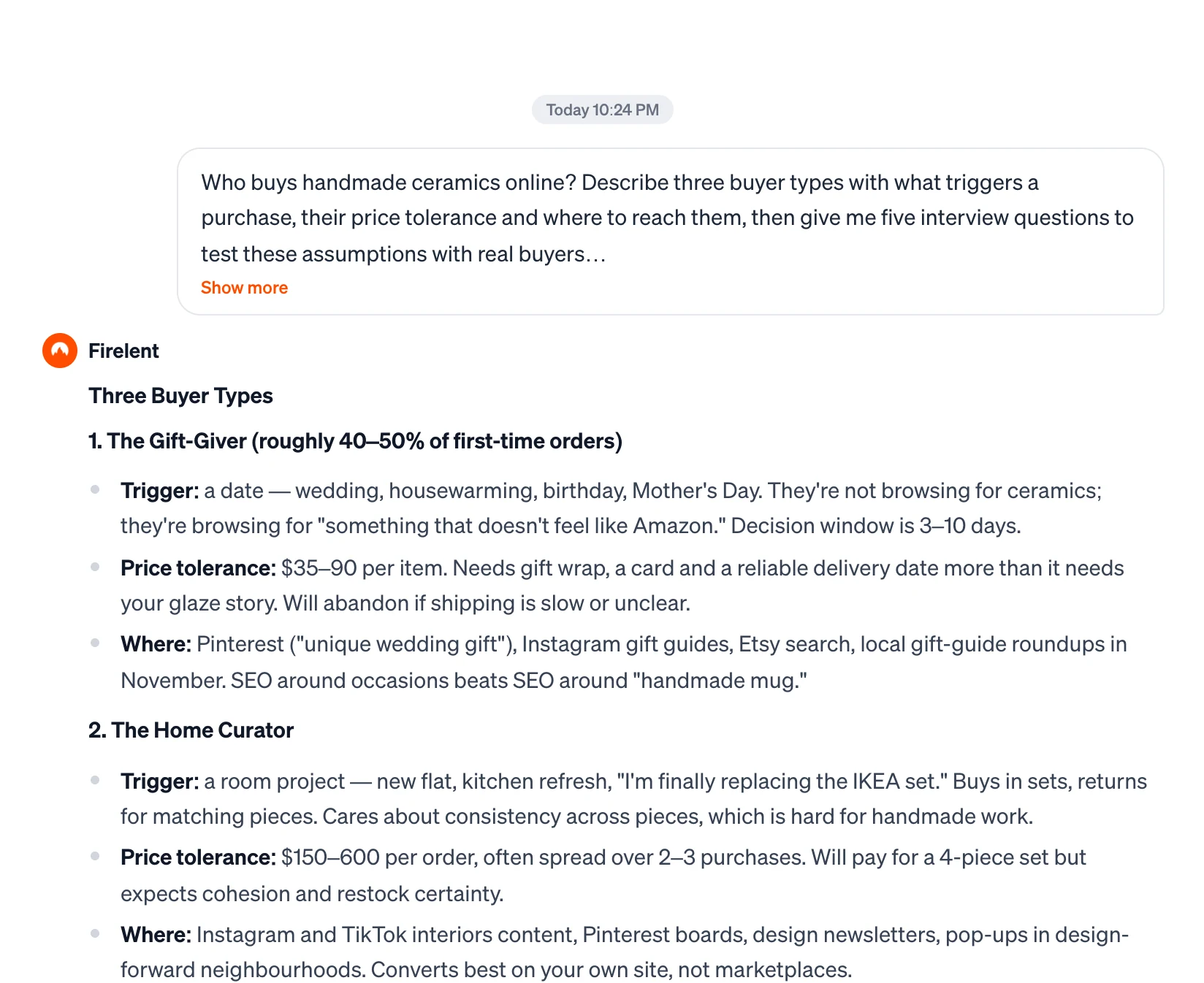
Who buys handmade ceramics online? Describe three buyer types with what triggers a purchase, their price tolerance and where to reach them, then give me five interview questions to test these assumptions with real buyers.
A sketch, not your customers
Firelent doesn't read reviews, forums or social media for research yet — the answer describes typical buyers from what the AI model knows. Shares like “40–50% of orders” are estimates. Treat every buyer type as a guess until real people confirm it.
What to ask for#
- Two or three buyer types, not ten. Each one described by what they're trying to get done — not just age and city.
- The trigger: the moment they start looking. A birthday, a broken boiler, a new job, a bad experience with someone else.
- What they compare you with — including doing nothing or doing it themselves.
- What stops them: price, trust, effort, timing.
- Where they are: the places, platforms and people they already listen to.
“A 35-year-old woman who likes design” helps less than “someone looking for a wedding gift under €80 that doesn't look mass-produced, two weeks before the date”. A useful format: When [situation], I want to [goal], so I can [outcome].
AI-written buyer types are good for preparing questions — not for deciding. They tend to sound more positive and tidier than real people, who drop out, forget and change their minds.
Then talk to real people#
The best customer research is a conversation. Five to ten good ones will teach you more than any report:
Find them
People who had the problem recently: existing customers, people in local groups and forums, friends of friends — not just friends.
Ask about the past, not the future
“When did you last buy a handmade gift? What did you look at first?” is useful. “Would you buy my mugs?” isn't — people are kind about the future.
Ask for specifics
What happened, what they tried, what it cost, what annoyed them. Stories beat opinions.
Don't pitch
Listen more than you talk. Your idea comes at the very end — if at all.
Write it down straight away
Their exact words are gold for your website later.
Compliments don't count — commitments do. If someone gives you their time again, introduces you to someone else or pays a deposit, that's a real signal.
Ask Firelent for the questions: “Give me ten interview questions about past behaviour, no hypotheticals, for people who recently [did the thing].”
Mine the reviews#
Your competitors' reviews are free customer research:
- Open your competitors on Google Maps and on review sites.
- Read the 1–3 star reviews first, then the 5-star ones.
- Copy the sentences that come up again and again.
- Paste them into the chat and ask: “Group these complaints and praises into themes, and turn each top complaint into a promise I could keep.”
Firelent can't fetch the reviews for you, but once you paste them in, it sorts them in seconds.
Turn it into decisions#
- Your headline: use the words customers use for their problem.
- Your offer: solve the top complaint and say so plainly.
- Your channels: go where your buyer types already are.
- Your proof: show the thing they worry about most — reviews, guarantees, photos, prices.
FAQ#
Can Firelent run a survey for me?#
Not directly — but you can build a page with a form and ask your questions there. The answers are saved under Project → Data.
How many conversations are enough?#
When you stop hearing new things — often after five to ten conversations per buyer type.