
Research / Pricing
Research
Pricing
What to charge and how to package it, with the numbers to back it up.
Price is the decision that changes your business most and gets the least thought. Firelent helps you compare pricing models, see typical ranges and design packages — so you start with a price you can defend, then test it with real customers.
Ask a pricing question#
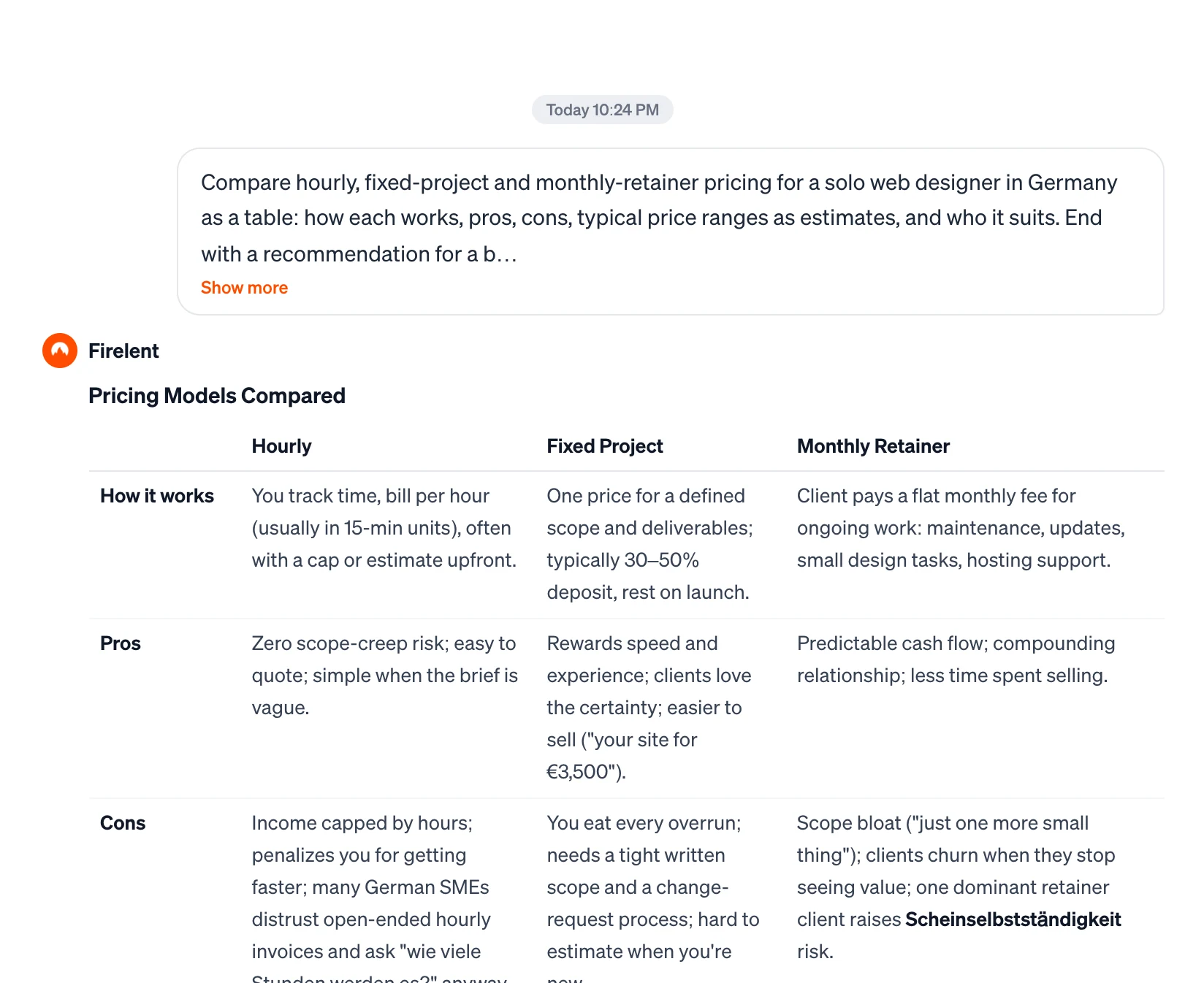
Open Research on your dashboard and choose Pricing. Pick Comparison under Deliver as to compare options side by side — and say “as a table” in your question for a reliable layout. Answers are free; see Competitors for how research works.
Compare hourly, fixed-project and monthly-retainer pricing for a solo web designer in Germany as a table: how each works, pros, cons, typical price ranges as estimates, and who it suits. End with a recommendation for a beginner.
Price ranges are estimates
Firelent doesn't look up live prices yet. Ranges in answers come from the AI model's knowledge and can be outdated or off for your area. Check real competitor prices before you publish yours — and check tax rules with a tax adviser.
Find your price in three steps#
Your floor: what it costs you
Add up your costs per sale — materials, time, fees, travel, a share of rent and tools. Below this number, every sale loses money.
The market: what others charge
Collect real prices from five to ten competitors. Note what's included, not just the number.
Your value: what it's worth to the customer
What does your customer gain or save? Time, money, worry, status. This is your ceiling — and usually higher than you think.
Your price sits between your floor and your ceiling. Where exactly depends on how you're different — see Competitors.
Package it#
- Offer three options. A basic, a recommended and a premium package. Most people choose the middle one — so make it the one you want to sell, and highlight it.
- Differ in outcome, not just quantity. “Website” / “Website + booking” / “Website + booking + monthly care” is clearer than three page counts.
- Anchor high. A premium option can make the middle one look reasonable — but tricks like this don't always work, so test them.
- Name what's included and what isn't, so there are no arguments later.
- Reward commitment. A discount for paying yearly or booking a series brings in money earlier.
Ask Firelent: “Design three packages for my offer, with names, what's included, prices and which one to highlight.”
Ask what people would pay#
Before you publish prices, ask a handful of potential customers four questions about your offer:
- At what price would it be so expensive you wouldn't consider it?
- At what price would it be expensive, but you'd still consider it?
- At what price would it be a bargain?
- At what price would it be so cheap you'd doubt the quality?
The range between “a bargain” and “expensive” is where your price can live. Even ten answers show you whether you're in the right area.
Test it for real#
- Put prices on a page and see who books or buys. Real behaviour beats any survey.
- Raise prices for new customers first, and watch whether they still say yes.
- If nobody ever says no, you're too cheap.
- Look at your prices again at least twice a year — costs and markets move.
With Firelent's Shop you can sell up to five products straight from your website.
FAQ#
Should I show prices on my website?#
For most small businesses, yes — even “from €…” builds trust and saves you calls from people who can't afford you. When you sell to consumers, show prices including VAT.
Can Firelent tell me what competitors charge right now?#
Not yet — it can't visit their websites. Collect the prices yourself, paste them into the chat, and ask Firelent to compare them.