
Research / SEO & Keywords
Research
SEO & Keywords
Find what people search for and plan the pages that answer it.
People find businesses by searching. Keyword research tells you what they type, what they mean by it, and which pages your website needs to answer them. Firelent gives you a first keyword plan in a minute — and shows you how to confirm it with real search data.
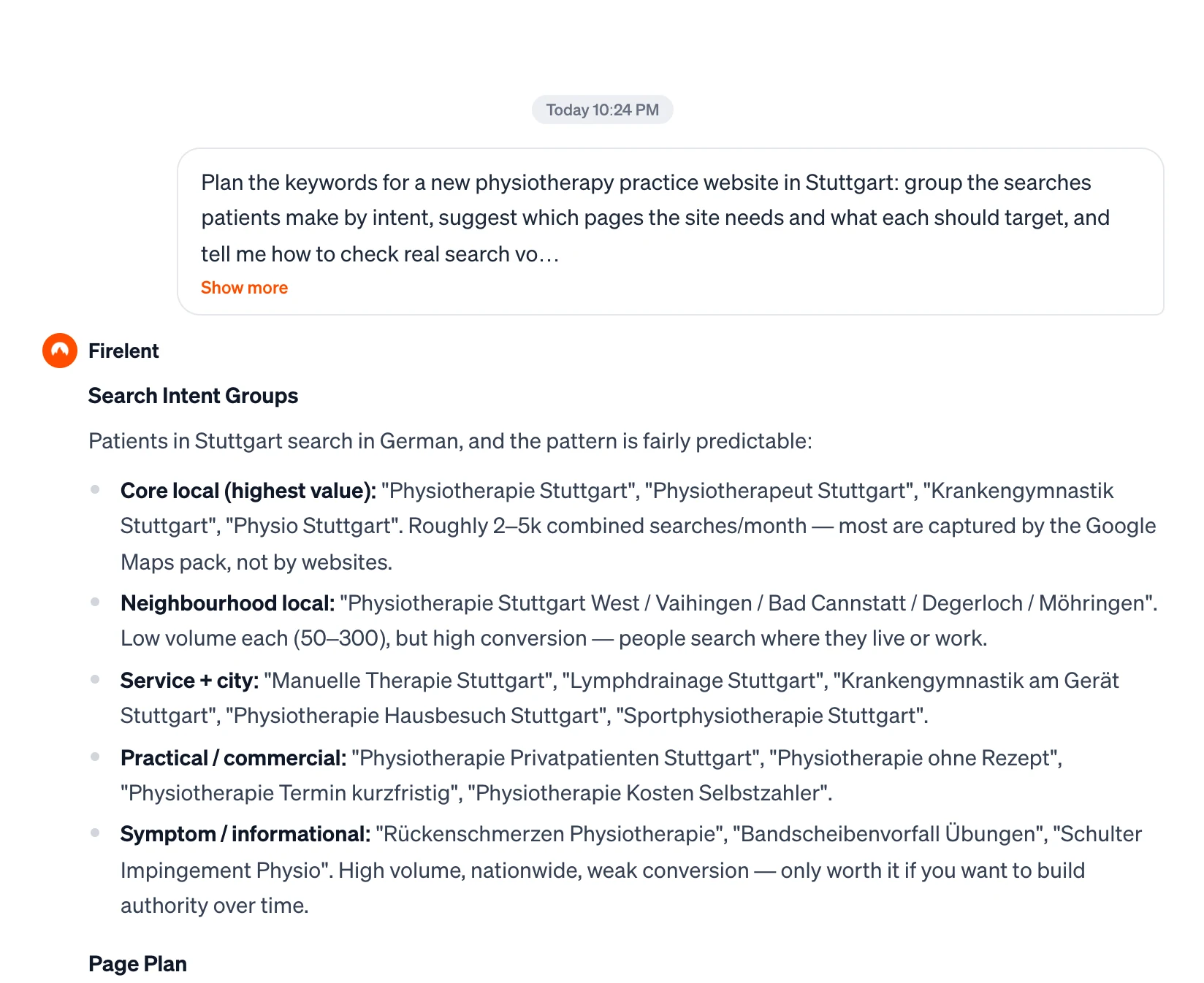
Ask for a keyword plan#
Open Research on your dashboard and choose SEO & Keywords. Answers are free and appear in the chat — see Competitors for how research works.
Plan the keywords for a new physiotherapy practice website in Stuttgart: group the searches patients make by intent, suggest which pages the site needs and what each should target, and tell me how to check real search volumes for free.
Search volumes in answers are guesses
Firelent doesn't have access to search data yet. When an answer says “roughly 2–5k searches a month”, that's the AI model's estimate, not a measurement. Use the answer for ideas and structure, and get real numbers from the free tools below.
Think in intent, not just words#
Every search has a purpose. Group your keywords by what the searcher wants:
| Intent | They want to… | Example | The page that answers it |
|---|---|---|---|
| Local | find someone nearby | “physio Stuttgart West” | Your homepage, with your area named |
| Commercial | compare before choosing | “physiotherapy without prescription cost” | A prices or services page |
| Transactional | act now | “book physiotherapy appointment” | A page with booking front and centre |
| Informational | understand a problem | “lower back pain exercises” | A helpful article — later, once the basics rank |
| Navigational | find you by name | “[your practice name]” | Your homepage — make sure your name is on it |
A new website ranks fastest for specific, local, ready-to-act searches. Broad terms like “back pain” are dominated by big health sites — aim for them later, if at all.
Plan your pages#
- One main topic per page. Each important service gets its own page, with its keyword in the headline.
- Name your place — city and districts — where it's natural.
- Answer the questions people ask right on the page: prices, how it works, how long it takes, what to bring.
- Use the searcher's words. If people search “Krankengymnastik”, don't only say “physiotherapy”.
Firelent websites get page titles and descriptions from your business details. Ask the chat to sharpen them for your keywords: “make the homepage title mention physiotherapy and Stuttgart West”. See Landing pages.
Check it yourself#
| Tool | Free | What it tells you |
|---|---|---|
| Google autocomplete and “People also ask” | Yes | What people really type, and the questions around it |
| Google Keyword Planner | Yes, with a Google Ads account | Search volume — as ranges, unless you run ads |
| Google Trends | Yes | Whether interest is rising or seasonal, as relative numbers |
| Google Search Console | Yes | The real searches that show your site, once it's live — the best data you'll ever have |
| The search results themselves | Yes | Who ranks today. If it's all directories and giant sites, pick a more specific keyword |
Once your site is live on your own domain, add it to Google Search Console. After a few weeks, it shows which searches you appear for. The quickest wins are searches where you're on position 8 to 20 with lots of impressions: sharpen those pages' titles and content, and they often move onto the first page. Paste the list into the Firelent chat and ask for better titles.
FAQ#
Can Firelent tell me where my website ranks?#
Not yet. Google Search Console shows you that for free once your site is live.
How long does SEO take?#
For a new site, expect weeks to months before you rank for anything competitive. Local, specific searches usually come first.